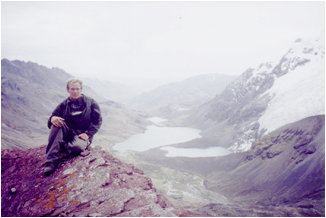
Christopher Howard House
Associate Professor of Geosciences
Director of the Penn State Astrobiology
Research Center
Director of the Pennsylvania Space
Grant Cosortium
Address:
Department of Geosciences
218 Deike Building
University Park, PA 16802
Email: chouse@geosc.psu.edu
Education:
B. S. in Biochemistry and Cell Biology, University of California, San Diego
Ph.D. in Geology,
University of California, Los Angeles
Dissertation Title:
"Carbon Isotopic Fractionation by Diverse Extant and
Fossil Prokaryotes
and
Microbial Phylogenetic Diversity Revealed through
Genomics"
RESEARCH INTERESTS
Microbial diversity and cultivation,
microbial paleontology, molecular evolution and genomics, astrobiology, & geomicrobiology
RESEARCH EXPERIENCE
Summer and Adjunct fellow with S.L. Miller (1993 and 1994)
NASA Specialized Center for Reseaerch and training in Exobiology (NSCORT)
Graduate
Fellow with J. W. Schopf (1996-1997)
UCLA Center for the study of Evolution
and the Origin of Life (CSEOL)
Visiting
Researcher with Karl O. Setter (1997)
Lehrstuhl
f��r Mikrobiologie, Regensburg, Germany
Teaching/Research Assistant (1996-1999)
Department of Earth and Space Sciences,
University of California, Los Angeles
Research Assistant (1989-1999)
IGPP Center for Astrobiology,
University of California, Los Angeles
Assistant
Professor of Geosciences (2000-2006)
Department of Geosciences, Penn State University
Associate
Professor of Geosciences (2006-)
Department of Geosciences
Penn State University
University Park, Pennsylvania
Penn State Astrobiology Research Center,
Director (2008-)
Penn State University
University Park, Pennsylvania
Pennsylvania
Space Grant Consortium, Director (2008-)
Penn State University
University Park,
Pennsylvania
SELECTED PUBLICATIONS
House, C.H. 2009. The Tree of Life viewed through the
contents of genomes. Methods in Molecular Biology, 532: 141-161.
Zerkle, A.L., C.K. Junium, D.E. Canfield,
and House, C.H., 2008. Production of 15N-depleted
biomass during cyanobacterial N2-fixation at high Fe
concentrations, J. Geophys. Res., 113: G03014.
Biddle, J.F.,
Fitz-Gibbon, S.T., Schuster, S.C., Brenchley, J.E., House, C.H., 2008. Metagenomic
signatures of the subseafloor biosphere. PNAS 105:
10583-10588.
Moran, J.J., House, C.H., Vrentas,
J.,M., Freeman, K.H., 2008. Methyl
Sulfide Production by a Novel Carbon Monoxide Metabolism in Methanosarcina
acetivorans.
Applied and
Environmental Microbiology.
74: 540-542.
Moran, J.J., Beal, E.J., Vrentas, J.M., Orphan,
V.J., Freeman, K.H., House, C.H., 2008. Methyl sulfides as intermediates in the
anaerobic oxidation of methane.
Environmental Microbiology. 10:
162
House, K.Z., House, C.H., Schrag, D.P., and Aziz,
M.J., 2007. Electrochemical
Acceleration of Chemical Weathering as an Energetically Feasible Approach to
Mitigating Anthropogenic Climate Change. Environ. Sci. Technol., 41, 24:
8464 – 8470
Moran, J.J., House, C.H., Thomas, B.,
Freeman, K.H., 2007. Products of trace methane oxidation during nonmethyltrophic
growth by Methanosarcina. Journal
of Geophysical Research, 112:
G02011.
Trueude, T., Orphan,
V., Knittel, K., Gieseke,
A., House, C.H., Boetius,
A., 2007. Consumption of methane
and CO2 by methanotrophic microbial mats
from gas seeps of the anoxic Black Sea.
Applied and
Environmental Microbiology.
Hausrath, E.M.,
Liermann, L.J., House,
C.H., Ferry, J.G., Brantley, S.L., 2007. The effect of methanogen growth on
mineral substrates: will Ni markers of methanogen-based
communities be detectable in the rock record? Geobiology, 5: 49-61.
Zerkle, A.J.,
House, C.H., Cox, R.P., Canfield,
D.E., 2006. Metal
limitation of cyanobacterial N2 fixation and
implications for the Precambrian nitrogen cycle. Geobiology, 4: 285-297.
Ferry, J.G, and House, C.H., 2006. The Stepwise
Evolution of Early Life Driven by Energy Conservation. Molecular
Biology and Evolution, 23:
1286-1292.
Biddle, J.F. Lipp, J.S.,
Lever, M., Lloyd, K., Sørensen, K., Anderson, R., Fredricks, H.F., Elvert, M.,
Kelly, T.J., Schrag, D.P., Sogin,
M.L., Brenchley, J.E., Teske,
A., House, C.H., Hinrichs.
K., 2006. Novel heterotrophic Archaea dominate sedimentary subsurface ecosystems off
Peru. Proceedings of the National Academy of Sciences, 103: 3846-3851.
Zerkle, A.L.,
House, C.H., and Brantley, S.,
2005 Genomic Study of
Biogeochemical Signatures for Microbial Metabolisms through Time. American
Journal of Science, 305 (“Oct., Sept., Nov.” Issue):
467-502.
Biddle, J.F., House, C.H., and Brenchley, J.E., 2005. Microbial stratification in deeply buried marine sediment
reflects changes in sulfate/methane geochemistry. Geobiology, 3: 287-295.
Biddle, J.F., House, C.H., and Brenchley, J.E., 2005. Enrichment cultivation of microorganisms
from sediment from the slope of the Peru Trench (ODP Site 1230). Proceedings of the Ocean Drilling
Program, Scientific Results, 201.
Moran, J. J., House, C. H.,
Freeman, K. H., and Ferry, J. G., 2005.
Trace methane oxidation studied in several Euryarchaeota
under diverse conditions. Archaea, 1: 293-301.
D’Hondt, S., and 34 others., 2004. Distributions of Microbial Activities in Deep Subseafloor
Sediments. Science, 306: 2216-2221. [Research Article]
Orphan, V. J., Ussler III, W., Naehr, T., House, C.H., Hinrichs,
K. U. and Paull, C. K., 2004. Geological, Geochemical, and Microbiological Heterogeneity of the
Seafloor Around Methane Vents in the Eel River Basin, offshore California. Chemical
Geology, 205: 265-289.
House, C.H., Runnegar, B., and Fitz-Gibbon, S.T., 2003. Geobiological analysis using whole
genome-based tree building applied to the Bacteria, Archaea,
and Eukarya. Geobiology, 1: 15-26.
House, C.H., Cragg, B., Teske,
A., and the Leg 201 Shipboard Scientific Party, 2003. Drilling Contamination Tests on ODP Leg 201 Using Chemical
and Particulate Tracers. Proceedings of the Ocean Drilling Program,
Initial Reports, 201: Ch. 2,
1-19.
House, C.H., Schopf, J.W., and Stetter,
K.O., 2003. Carbon
isotopic fractionation by Archaeans and other thermophilic Prokaryotes. Organic Geochemistry,
34: 345-356.
Orphan, V.J., House, C.H., Hinrichs, K.U., McKeegan, K.D., and DeLong, E.F.,
2002. Multiple archaeal
groups mediate methane oxidation in anoxic cold seep sediments. Proceedings
of the National Academy of Sciences, 99: 7663-7668.
House, C.H. and Fitz-Gibbon, S.T., 2002. Using Homolog Groups to Create a Whole-Genomic
Tree of Free-living Organisms: an Update: Journal
of Molecular Evolution, 53: 539-547.
Orphan, V. J., House, C. H.,
Hinrichs, K.U., McKeegan, K.D., DeLong, E.F.,
2001. Methane-Consuming Archaea Revealed by Directly Coupled Isotopic and Phylogenetic Analysis. Science, 293: 484-487.
House, C. H., Schopf,
J.W., McKeegan, K.D., Coath, C. D., Harrison, T. M., and Stetter,
K. O., 2000. Carbon
isotopic composition of individual Precambrian microfossils. Geology,
28: 707-710.
Fitz-Gibbon, S.T. and House,
C.H.,
1999. Whole Genome-based Phylogenetic
Analysis of Free-Living Microorganisms. Nucleic
Acids Research, 27:
4218-4222
House, C.H. and Miller, S.L., 1996, Hydrolysis of dihydrouridine
and related compounds. Biochemistry, 35: 315-320.
INVITED LECTURES
Rensselaer
Polytechnic Institute. Spring 2009. Title: Moving beyond sulfate-dependent methane oxidation in cold
seeps.
Penn State University, Fall 2008. Title: Linking taxonomy with Environmental Chemistry in Marine Sediments.
Central State University, Spring
2007. Title: Probing the
Microbiology of Deeply Buried Marine Sediments.
University of Eastern Kentucky, Spring
2007. Title: Probing the
Microbiology of Deeply Buried Marine Sediments.
University of Arkansas, Spring 2007. Title: Probing the Microbiology of
Deeply Buried Marine Sediments.
University of Texas, Arlington, Spring
2007. Title: Probing the
Microbiology of Deeply Buried Marine Sediments.
Penn State University, Spring 2007. Title: Methane munching microbes meandering on margins.
La Salle University, Fall 2006. Title: Probing the Microbiology of Deeply Buried Marine Sediments.
University
of Idaho, Fall 2006.
First
title: Linking Taxonomy with
Environmental Geochemistry: The
Anaerobic Oxidation of Methane in Cold Seeps.
Second
title: Probing the Microbiology of
Deeply Buried Marine Sediments
Caltech, Fall 2006. Title: Gene Sequences, Gene Content, and Gene Order: Trying to find a “Genomic” Record for Geobiology.
University
of California, Riverside. Fall
2006. Title: Probing the Microbiology of Deeply
Buried Marine Sediments.
University
of California, Los Angeles. Fall
2006. Title: Margins, Methane, and
Microbes..
Harvard
University. Fall 2004. Title: Anaerobic methanotrophs
in the marine subsurface.
NASA Astrobiology Institute Director’s
Seminar. Fall 2004. Title: Anaerobic methanotrophs
in the marine subsurface.
Rutgers
University. Fall 2004. Title: Anaerobic methanotrophs
in the marine subsurface.
University of Maryland, Center for
Environmental Science / Chesapeake Biological Laboratory.
Fall 2003. Title: The
carbon isotopic analysis of microbial cells: Investigations into the anaerobic
oxidation of methane.
Rensselaer
Polytechnic Institute. New York Center for Studies on the Origin of Life. Fall 2003. Title: Tracing the Microbial
Tree of Life: Novel Approaches
Using Geochemistry and Genomics.
University
of California, Santa Cruz. Department of Molecular Biology. Fall 2002. Title: The Carbon Isotopic Analysis of Individual
Modern or Fossil Cells, a Geochemical Approach to Studying Biochemistry.
Penn
State University. Department of Geosciences. Fall 2002.
Title: The Carbon Isotopic Analysis of Individual Modern or Fossil
Cells, a Geochemical Approach to Studying Biochemistry.
University of North Carolina at Chapel
Hill. Department of Marine
Sciences. Fall 2002. Title: The Carbon Isotopic Analysis of
Individual Modern or Fossil Cells, a Geochemical Approach to Studying
Biochemistry.
Ohio
State University. Department of Geological Sciences Lunch Brownbag. Spring 2002. Title: Of microbes and men (people): Whole genome-based phylogenetics
applied to Bacteria, Archaea, and Eukarya.
Ohio
State University. Department of Geological Sciences Colloquium Series. Spring 2002. Title: The Carbon Isotopic Analysis of Individual Modern or
Fossil Cells, a Geochemical Approach to Studying Biochemistry.
Woods
Hole Oceanographic Institute. Fall
2001. Title: Of microbes and men
(people): Whole genome-based phylogenetics applied to Bacteria, Archaea,
and Eukarya.
Monterey Bay Aquarium Research Institute
Colloquium Series. Fall 2001. Title: Novel approaches for microbial geochemistry and for
microbial phylogenetics.
University
of Massachusetts, Lowell. Department of Biology Colloquium
Series. Spring 2001. Title: Novel approaches for microbial phylogenetics and for microbial geochemistry.
State
University of New York at Stony Brook Department of Geosciences Colloquium
Series. Spring 2001. Title: Culture-independent study of
carbon metabolism in microorganisms from the environment and from the fossil
record.
University of Rochester, Department of
Earth and Environmental Science Colloquium Series.
Fall 2000. Title: Examining Microbial Diversity in the
Precambrian.
University of Maryland, Department of
Geology Colloquium Series. Fall 2000. Title:
Examining Microbial Diversity in the Precambrian.
Arizona
State University, Geology Colloquium Series. Fall 1999.
Title: From Genomes to
Microfossils: The Search for Ancient Biochemical Diversity.
Carnegie Institute of Washington Seminar
Series. Fall 1999. Title: From
Genomes to Microfossils: The Search for Ancient Biochemical Diversity.
University of Chicago, Department of
Geophysical Sciences Colloquium Series. Fall
1999. Title: From Genomes to Microfossils: The
Search for Ancient Biochemical Diversity.
University of California, Los
Angeles, Institute of Geophysics and Planetary Physics Astrobiology Seminar
Series. Spring 1999. Title: From
Genomes to Microfossils: The Search for Ancient Biochemical Diversity.
Washington University in St. Louis, Department of Earth and
Planetary Sciences Colloquium Series.
Spring 1999. Title: From Genomes to Microfossils: The Search for Ancient
Biochemical Diversity.
MEMBERSHIP IN PROFESSIONAL ORGANIZATIONS
American Geophysical
Union
American Society for Microbiology
Geochemical Society
International Society for the Study of the Origin of Life
DATA FILES FROM GENOMIC PUBLICATIONS
2005 American Journal of
Science (AJS) paper