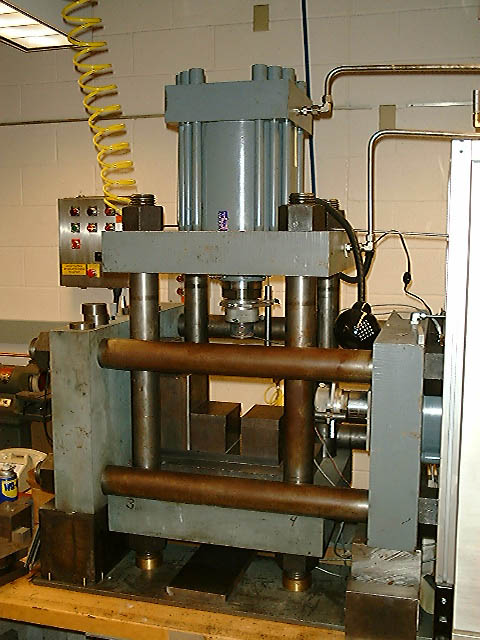
Penn State Rock Mechanics Lab: Biaxial Deformation Apparatus


The Penn State rock mechanics lab has a state-of-the-art, servo-hydraulic biaxial testing apparatus.  The vertical load frame has a maximum force of 1MN and the horizontal frame can produce forces up to 800kN.  Each load frame may be operated in displacement- or load-feedback servo control. Displacement control resolution is 0.1 micron for each axis and load resolution is <0.1kN.  The apparatus is powered by a 20 GPM, 50 hp hydraulic power supply.  Servo-controlled load point displacement rates of 0.01 micron/s to 2 cm/s are possible.

The apparatus is set-up primarily for double direct shear friction studies and is capable of normal stresses up to 40 MPa on samples of nominal contact dimension 15 cm x 15 cm.  Machine stiffness is roughly 4 MN/cm and therefore ideal for friction and fracture studies.
 

Animation of Apparatus used in Double-Direct Shear Configuration

Animation of Apparatus with Pressure Vessel

For more information contact: Prof. Chris Marone
 

Current Research
 

  • Mechanics of the critical slip distance and application of laboratory data to seismic faulting
  • The rate of fault healing and implications for friction constitutive laws
  • Numerical studies of earthquake nucleation and dynamic rupture propagation
  • Numerical modeling of friction data and inversion for friction constitutive parameters
  • Upper stability transition on mature faults and the mechanics of earthquake afterslip
  • Frictional behavior of smectite and illite-rich clay gouges with application to the mechanics of subduction zone megathursts
  • Influence of grain characteristics on the friction of granular shear zones
  • The effect of humidity on granular friction
  • Creep and frictional behavior of laboratory fault zones subject to time-dependent fluctuations of normal and shear load
  • Friction and shear heating at high velocity
  • Effect of shear load, including true stationary contact, on frictional healing
  • Effect on frictional healing of loading rate and accumulated displacement
  • Apparatus installation