


Karen Pham
Title
Ph.D. Candidate


My research focuses on using siderite (iron carbonate, FeCO3), a unique carbonate mineral, to reconstruct ancient Earth environments. Siderite is redox-sensitive and requires specific physiochemical conditions to precipitate and remain stable. This sensitivity makes it particularly valuable for preserving paleoenvironmental information, especially during critical periods in Earth's history when unique conditions favored siderite formation. Siderite offers a key advantage for paleoenvironmental reconstruction due to its low solubility. While other carbonate minerals may undergo dissolution and reprecipitation that can alter their primary geochemical signatures, siderite tends to remain stable and preserve its original environmental record. This stability makes it an exceptional archive of past conditions. To extract paleoenvironmental information from siderite, I employ multiple analytical approaches. I analyze stable isotopes (carbon, oxygen, and clumped isotopes) and integrate these geochemical data with sedimentological and petrographic observations.

My research focuses on using seismic methods, particularly surface waves analysis and distributed acoustic sensing (DAS), to monitor subsurface changes in diverse environments such as permafrost and urban areas. I am particularly interested in understanding the impacts of permafrost thaw and degradation and assessing how we can use seismic methods to track those changes.



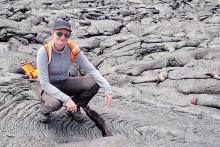
Christelle Wauthier, associate professor of geosciences in the College of Earth and Mineral Sciences, received a Faculty Early Career Development Program (CAREER) Award from the National Science Foundation to develop numerical models to characterize volcanic flank instability processes.
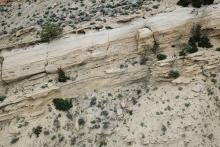
In a field exercise, geosciences student Katie Reilly moved from point to point, analyzing surface geological formations, hoping to gain insight into the environmental conditions that formed portions of the Rocky Mountains.
For experienced undergraduate students in Penn State's College of Earth and Mineral Sciences, this capstone field camp is a rite of passage. Each year, dozens of students usually spend six weeks exploring the topography and geologic features of the Western United States, analyzing firsthand the expression of forces that they’ve spent years learning.

Roman DiBiase won’t soon forget the name of an early mentor when he began his career at Penn State in 2014.
He was recently named the Rudy L. Slingerland Early Career Professor of Geosciences, a distinction that honors the now retired Penn State professor and will help fund DiBiase’s research studying how landscapes erode over geologic time, shaping mountains and in an instant leading to hazards from fires, floods and landslides.
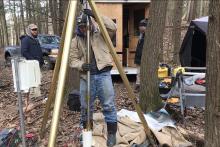
UNIVERSITY PARK, Pa. — Chemical reactions deep below ground affect water quality, but methods for “seeing” them are time-consuming, expensive and limited in scope. A Penn State-led research team found that seismic waves can help to identify these reactions under an entire watershed and protect groundwater resources.