Nisa Downey
Title
M.S. Candidate
Department of Geosciences



Amina is a PhD student in the Department of Geosciences at Penn State University. She is a water scientist and climate enthusiast with broad interests in environmental and water resources management, effects of land use and changes, climate dynamics impacts, and sustainable management practices. Currently, her research examines nutrient pollution along the Pennsylvania coastline of Lake Erie, specifically evaluating how agricultural practices in grape farming and groundwater discharge contribute to the Lake’s eutrophication. Through her work, Amina aims to identify sources of nutrient runoff and analyze the spatial and temporal dynamics of nutrient distribution in the region.
Before joining the Geosciences Department at Penn State, Amina earned a Master of Science in Geological Sciences with a certificate in Geographic Information Systems from Illinois State University, where she researched the impact of tile drainage water on groundwater nitrate concentrations within a saturated riparian buffer zone. She also holds a Bachelor of Technology in Applied Geology from the Federal University of Technology, Akure, Nigeria. Passionate about fostering collaboration and knowledge exchange, Amina actively participates in professional organizations and community outreach. Her dedication to bridging scientific research with practical applications underscores her commitment to advancing sustainable environmental management. Outside of her academics and research pursuits, Amina enjoys watching documentaries, and law and medical series.
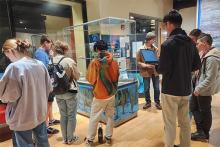
Graduate student Kaitlyn Horisk spearheaded a new exhibit, "Cretaceous Oceans and Climate," in the EMS Museum and Art Gallery.
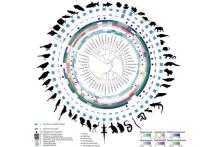
An international research collaboration has sequenced the genomes of 51 species using a new genome assembly pipeline in the Galaxy platform that reduces sequencing time from months to days. The development deepens our understanding of evolution and the links between humans and animals. Credit: LaRieviere et al., 2024. Nature Biotechnology.
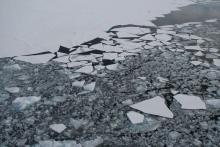
Arctic sea ice is shrinking as the world continues to warm, and a new study led by researchers at Penn State may provide a better understanding of how the loss of this ice may impact daily weather in the middle latitudes, like the United States.

Andrew Nyblade took over the Department of Geosciences in 2019 and steered the department through a global pandemic while creating key faculty hires.

Scans of the a giant fossil legume revealed the extinct species is a relative to the modern black bean tree.

The 10th Street Bypass in Pittsburgh: Penn State students, Carnegie Mellon students, Penn State faculty and staff from the Franco Harris Pittsburgh Center at Penn State are collaborating to use existing fiber optic cables to predict dangerous potential geohazards like flooding, landslides and sinkholes in Pittsburgh.